Humairah Font: A Designer's Review of a Modern Script Workhorse
I clicked the blank canvas in my design software, the familiar mix of excitement and mild dread that comes with starting a new brand board. This project was for a local ceramics studio – think hand-thrown mugs, artisanal plates, a vibe that was both earthy and elegant. They needed something that felt personal and crafted, but not overly rustic or casual. I had a mood board full of textured neutrals and subtle glaze colors, but the typography was the missing piece. I scrolled through my usual script suspects, but they all felt either too formal or too whimsical. That’s when I remembered the new addition to my library: Humairah.
First Impressions: Where Humairah Shines and Surprises
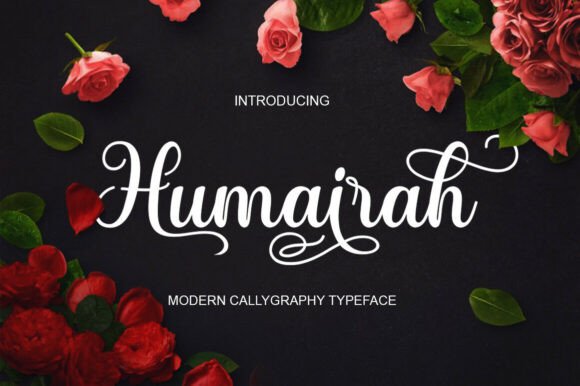
Dropping the studio's name, "Kiln & Craft," into a logo draft using Humairah was an immediate "aha" moment. The font carries a distinct modern sensibility. It’s a script, yes, but it’s not trying to mimic frantic handwriting or overly ornate calligraphy. The strokes are confident and clean, with a subtle bounce that feels organic rather than forced. There’s a beautiful balance here – it’s friendly enough for a creative business but retains a level of sophistication that prevents it from feeling childish. In that first logo test, it bridged the gap between "handmade" and "high-end" perfectly.
On the brand board, I tested it across applications: the primary logo, a submark for tags, and a simple wordmark for social profiles. Humairah held its own in each instance. The characters connect smoothly, creating a fluid, uninterrupted line that’s ideal for logotype work. I particularly appreciated the lowercase 'k' and 'f', which have just enough unique flair to be interesting without becoming distracting. This isn't a font that shouts for attention; it earns it through graceful execution.
Putting Humairah to Work in Real Brand Assets
The real test for any display font is how it translates from screen to physical mockups and varied digital layouts. For the ceramics studio, I pushed Humairah into several realistic scenarios:
- Packaging & Labels: On a brown craft paper mockup for a mug box, the font, stamped in a deep terracotta ink, looked exceptional. It felt bespoke, like a potter’s own signature on their work. The readability remained strong even at smaller sizes for ingredient or care labels.
- Business Cards & Stationery: Paired with a simple, sturdy sans-serif for contact details (I used Inter), Humairah as the name anchor created a perfect visual hierarchy. It was the personality, and the sans-serif was the clear, functional voice.
- Digital Presence: In a website header mockup, set against a textured background image of clay, the studio name in Humairah provided a warm, human counterpoint. For social media graphics announcing new glaze collections, it worked beautifully as a headline overlay, especially when I used its alternates to vary the letters in repeated words.
This is where Humairah’s "modern" classification proves true. It doesn’t get lost or feel out of place in digital spaces, a common pitfall for some more traditional scripts. It renders cleanly on screens, making it a viable choice for web font use, provided it’s used sparingly for headlines or accent text.
Ideal Pairings and Practical Considerations
Humairah, like most script fonts, is a team player. It’s a display font at heart, best used for headlines, logos, short phrases, and accent text. You wouldn’t set a lengthy terms-and-conditions page in it. Its strength is in creating a focal point. For pairing, my go-to strategy is contrast. A clean, geometric sans-serif (like Montserrat or Poppins) provides a fantastic modern base that lets Humairah pop. For a softer, more editorial feel, a neutral serif with moderate contrast (think Source Serif Pro) works wonderfully.
A note on limitations: While its readability is good for a script, avoid using Humairah at very small sizes or in all-caps settings (if the font supports it), as the connected letters can become a bit muddy. It’s also not the right fit for ultra-corporate, tech, or institutional branding where clarity and neutrality are paramount. This font has too much inherent character for that.
Is Humairah the Right Fit for Your Project?
After testing it across this branding project, I’d categorize Humairah as a versatile workhorse within the script category. It’s not the wild, decorative piece of art you’d use for a single fancy headline, nor is it the overly casual handwritten note. It occupies that valuable middle ground—a reliable, elegant script that can serve as the primary brand typeface for the right business.
Consider Humairah for:
- Boutique retail brands (clothing, ceramics, jewelry)
- Creative studios and freelancers
- Food & beverage businesses (artisan bakeries, specialty cafés, wine labels)
- Beauty and skincare with a natural, elegant positioning
- Wedding and event design for invitations and signage
- Any brand wanting to convey crafted, personal, and sophisticated moods.
If your project leans towards stark minimalism, hyper-tech, or requires extensive long-form body text, you might look elsewhere. But for projects that benefit from a touch of human, artisanal warmth without sacrificing a contemporary feel, it’s a compelling contender.
A Final, Practical Tip from the Trenches
Before committing Humairah to a final client project, do exactly what I did: create realistic mockups. Place it on a product, see it in a website header, print it on cardstock. Check its behavior in the specific contexts you’ll use it. Also, and this is crucial, always review the commercial license. Ensure it covers your intended use—whether that’s for a client’s permanent brand identity, packaging that will be mass-produced, merchandise, or embedding as a webfont. Understanding the license is as important as loving the letterforms.
In the end, for that ceramics studio brand, Humairah was the clear winner. It provided the distinctive voice the identity needed. It’s a font that doesn’t just sit on the page; it adds a layer of considered character. In a world of default system fonts, that’s a valuable tool for any designer looking to create work that feels both personal and professional.